Mary Berry’s scone recipe combines self-raising flour, butter, eggs, and milk to create light, golden scones in under 30 minutes. The BBC version makes 16 small scones baked at 220°C for 12–15 minutes. Her key rule: don’t overwork the dough and never twist the cutter. Serve warm with clotted cream and strawberry jam.
Few baked goods carry as much cultural weight as the British scone. Flaky on the outside, tender in the middle, and best eaten within hours of leaving the oven a great scone is simple in theory but surprisingly easy to get wrong. Mary Berry has spent decades making it foolproof.
Who Is Mary Berry and Why Do Her Scones Matter?
Dame Mary Berry is one of Britain’s most respected baking authorities. Best known as a judge on The Great British Bake Off, she has authored dozens of cookbooks and introduced millions of home bakers to reliable, accessible British baking. Her scone recipe isn’t just popular it’s a masterclass in restraint. She uses a short ingredient list, clear technique, and precise temperature to consistently deliver scones that rise tall and taste buttery without being fussy.
What separates her recipe from the thousands of others online is a small set of specific techniques she repeats across every version she’s published: cold liquid, minimal handling, and a straight cutter press. Each one has a measurable effect on the final result.
A Brief History of the British Scone
The scone doesn’t belong to Devon or Cornwall it belongs to Scotland. According to food historian Neil Buttery (Knead to Know: A History of Baking, 2024), the word “scone” dates to the early 16th century, and the original versions were cooked on iron griddles, not in ovens. They were made from oats or barley, not wheat flour.
As Catherine Brown and Laura Mason noted in The Taste of Britain (1999), scones are “as Scottish as oatmeal porridge” a fact many English bakers would find surprising. Oven-baked cream tea scones didn’t appear widely in English recipes until the early 20th century. By the time Mary Berry started publishing, the modern scone had settled into its familiar form: chemically leavened, baked hot, and served with jam and cream.
Mary Berry Scones Recipe BBC Version
Recipe Overview
|
Detail |
Info |
|
Prep time |
Under 30 minutes |
|
Cook time |
12–15 minutes |
|
Servings |
16 small scones |
|
Calories |
167 kcal per scone |
|
Difficulty |
Easy |
|
Best eaten |
Same day |
|
Freezer-friendly |
Yes |
Ingredients
- 450g (1 lb) self-raising flour
- 2 level tsp baking powder
- 50g (1¾ oz) caster sugar
- 100g (3½ oz) butter, slightly softened and cut into pieces
- 2 free-range eggs
- Milk (enough to bring the egg and milk total to 300ml)
- Handful of sultanas (optional)
To serve: strawberry jam and clotted cream
Step-by-Step Instructions
- Preheat the oven to 220°C/200°C Fan/Gas 7. Lightly grease two large baking trays.
- Combine the flour, baking powder, and sugar in a large bowl. Add the butter and rub in with your fingertips until the mixture resembles fine breadcrumbs.
- Crack the eggs into a measuring jug. Add milk until the total liquid reaches 300ml. Stir together.
- Pour most of the liquid into the flour bowl and stir with a round-tipped knife until a soft, slightly sticky dough forms. Do not overwork.
- Turn out onto a lightly floured surface and knead gently. Work in sultanas if using. Roll out to about 2cm (¾ in) thick.
- Cut out rounds using a fluted 5cm (2 in) cutter. Press straight down never twist. Place on prepared trays and brush tops with remaining milk and egg.
- Bake for 12–15 minutes until well risen and pale golden. Cool briefly on a wire rack.
What Are Mary Berry’s 6 Top Tips for Perfect Scones?
These tips come directly from the BBC recipe page and are consistently repeated across her books:
- Sieve the flour and baking powder together for even distribution of the rising agent.
- Keep everything cool use fridge-cold milk and eggs, and softened (not melting) butter.
- Don’t overwork the dough. Once it comes together, handle it as little as possible.
- The dough should be soft and slightly sticky. Too much flour equals heavy scones.
- Roll to exactly 2cm thick. Too thin = flat scones. Too thick = leaning scones.
- Press the cutter straight down and lift straight up. Twisting seals the edges and prevents an even rise.
Mary Berry Scones Buttermilk Variation
Mary Berry’s buttermilk scone recipe appears in Mary Berry at Home and is the only buttermilk scone across all 28 of her cookbooks. According to Pinch Perfect’s tested version of the recipe, this is how it differs from the standard BBC version:
How Does Buttermilk Change the Scones?
Buttermilk is acidic. That acidity reacts with baking powder to produce extra carbon dioxide, giving the scones a taller, lighter rise. The acid also weakens gluten strands in the flour, resulting in a softer, more tender crumb. Berry herself states in the recipe that “buttermilk gives a lovely, light texture.”
Buttermilk Scone Ingredients
- 450g (1 lb) self-raising flour
- 2 heaped tsp baking powder
- 75g (3 oz) butter, cubed
- 75g (3 oz) caster sugar
- 100g (4 oz) sultanas
- 2 large eggs, beaten
- 1 × 284ml carton buttermilk
Makes: 12 scones using a 6cm cutter | Bake: 200°C Fan/Gas 7 for 12–15 minutes | Thickness: Roll to 2.5cm (1 in)
Milk vs. Buttermilk: Which Should You Use?
|
Feature |
Milk Scones (BBC) |
Buttermilk Scones |
|
Rise height |
Standard |
Taller |
|
Texture |
Light and fluffy |
Softer, more tender |
|
Flavour |
Neutral, buttery |
Slightly tangy |
|
Calories |
167 kcal |
245 kcal |
|
Servings |
16 (5cm cutter) |
12 (6cm cutter) |
|
Roll thickness |
2cm |
2.5cm |
|
Best for |
Classic cream tea |
Standalone treat |
Choose milk if you want a traditional, neutral scone suited to afternoon tea. Choose buttermilk if you want more height, a softer crumb, and a richer flavour you can eat on its own.
What Is a Simple Scone Recipe with Milk for Beginners?
Mary Berry’s classic BBC recipe is already beginner-friendly, but her website’s Classic Special Scones version is even simpler and makes a smaller batch:
Quick Milk Scone Ingredients (makes ~8–10):
- 225g self-raising flour
- 1 tsp baking powder
- 50g butter
- 25g caster sugar
- 1 large egg
- Milk (to bind)
Method is identical to the full BBC version. This is a great starting point if you’re making scones for the first time or just want a quick batch without measuring out large quantities.
What Are the Best Variations of Mary Berry Scones?
|
Variation |
Key Change |
Best Served With |
|
Plain scones |
No fruit |
Jam, clotted cream |
|
Fruit/sultana scones |
Add 100g sultanas |
Butter or cream |
|
Cheese scones |
Replace sugar with 75g grated cheddar |
Soup, butter |
|
Lemon scones |
Add lemon zest + replace some sugar |
Lemon curd, cream |
|
Gluten-free |
Use certified GF self-raising flour |
Any topping |
How to Store, Freeze, and Reheat Mary Berry Scones
- Same day: Scones are best eaten fresh from the oven.
- Up to 1 day ahead: Store in an airtight container and reheat in a hot oven for a few minutes before serving.
- Freezing: Cool completely, freeze individually on a tray, then transfer to a freezer bag. Use within one month.
- Reheating: Defrost at room temperature, then warm in a 220°C/200°C Fan oven for 5 minutes.
Why Aren’t My Scones Rising? A Troubleshooting Guide
- Flat scones: Dough rolled too thin (should be 2cm). Baking powder may be old check the expiry date.
- Dense scones: Dough was overworked. Stop mixing as soon as the dough comes together.
- Leaning scones: Cutter was twisted when stamping out. Always press straight down and lift straight up.
- Hard scones: Too much flour was used while rolling. Use only a light dusting on the work surface.
- Pale tops: Egg wash brushed down the sides will prevent the rise. Brush only the flat tops.
The Great Cream Tea Debate: Jam First or Cream First?
Mary Berry’s BBC recipe leaves this open: “whether jam-and-cream-topped (in whichever order you like).” Cornwall traditionally puts cream first; Devon puts jam first. Neither is wrong. What matters is that the scone is fresh, the cream is clotted (not whipped), and the jam is strawberry.
Frequently Asked Questions
What flour does Mary Berry use in her scone recipe?
Mary Berry uses self-raising flour in all her scone recipes, combined with additional baking powder. Self-raising flour already contains a raising agent, and the extra baking powder boosts the rise further.
Why does the BBC recipe mix eggs and milk together before adding to the flour?
Combining the eggs and milk in a measuring jug ensures the total liquid volume reaches exactly 300ml. This precise ratio produces a dough that is soft and slightly sticky the exact consistency needed for light scones.
Can you make Mary Berry scones without eggs?
Eggs add structure and richness. If substituting, use an extra 50ml of milk plus 1 tablespoon of plain yoghurt per egg. The texture will be slightly less rich but still workable.
What temperature does Mary Berry bake scones at?
The BBC recipe bakes scones at 220°C/200°C Fan/Gas 7. The buttermilk version from Mary Berry at Home uses 200°C Fan/Gas 7 because the thicker dough (2.5cm) needs a slightly more moderate heat.
How many calories are in one Mary Berry scone?
The BBC recipe version contains 167 kcal per scone. The buttermilk and sultana version from Mary Berry at Home contains approximately 245 kcal per scone, reflecting the higher sugar content and larger size.
What is the difference between Mary Berry’s BBC scones and her Classic Special Scones?
The BBC version uses 450g flour and makes 16 small scones. The Classic Special Scones on maryberry.co.uk use 225g flour and make approximately 8–10 scones. The method and ratios are similar the BBC version is simply a larger batch.
Can you use plain flour instead of self-raising flour in Mary Berry scones?
Yes, but you need to add 2 level teaspoons of baking powder per 225g of plain flour to replicate the lift. The texture may differ slightly since the raising agent in self-raising flour is more evenly distributed through the flour during milling.
Can you substitute yoghurt for buttermilk in Mary Berry’s buttermilk scone recipe?
According to Pinch Perfect’s tested comparison, a 50/50 mix of natural yoghurt and whole milk (totalling 284ml) works as a substitute. Full-fat yoghurt performs better than low-fat. Greek yoghurt should be thinned with milk first, as it is too thick to pour.
Why does Mary Berry say not to chill scone dough before baking?
The BBC recipe explicitly states that chilling is unnecessary when using self-raising flour. Recipes that call for strong bread flour may require resting due to higher gluten content, but Mary Berry’s standard recipe does not.
Are scones Scottish or English?
Scones originated in Scotland, not Devon or Cornwall. According to The Taste of Britain (1999) by Catherine Brown and Laura Mason, scones are “as Scottish as oatmeal porridge.” The early Scottish versions were cooked on griddles and made from oats or barley. Oven-baked cream tea scones became popular in England in the early 20th century.
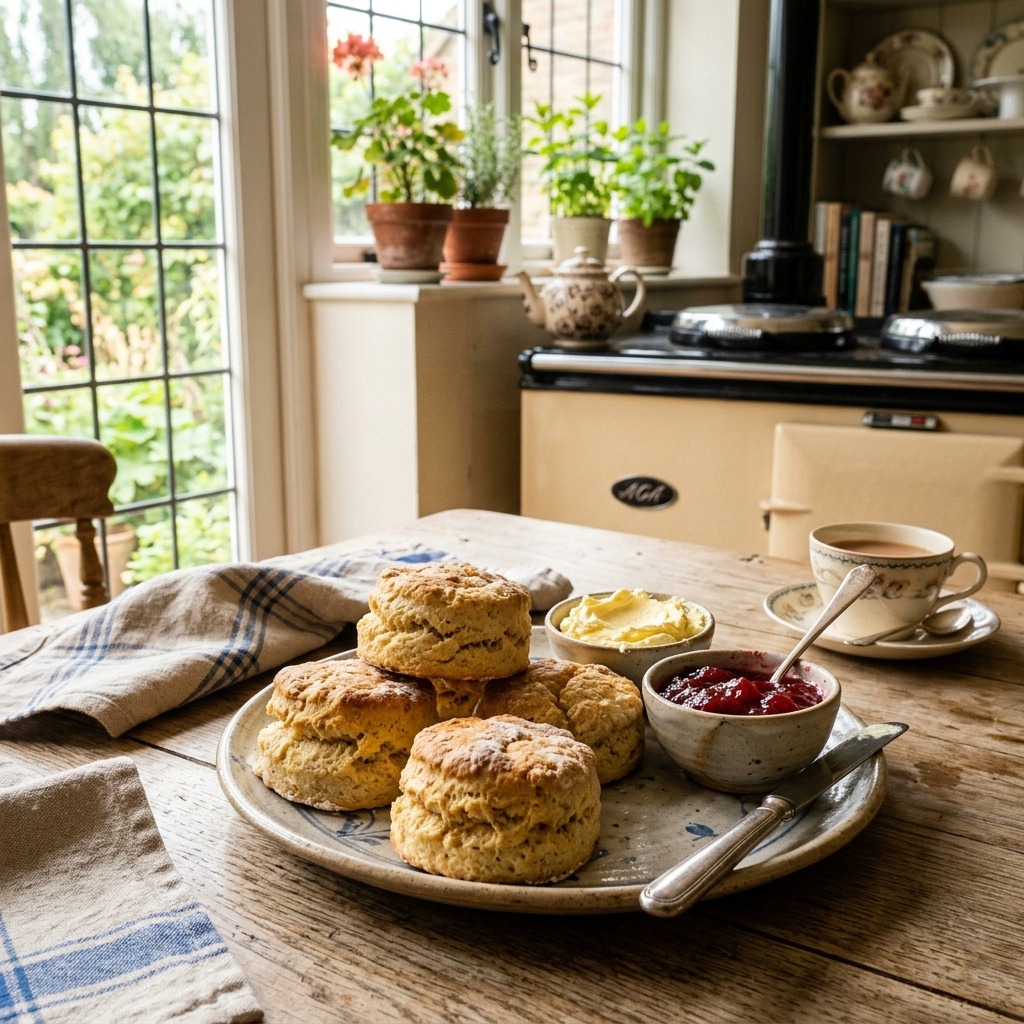
Mary Berry Scones: Easy BBC Recipe, Tips & Buttermilk Version
Ingredients
Instructions
-
preheat your oven
Preheat the oven to 220°C/200°C Fan/Gas 7. Lightly grease two large baking trays. -
combine all ingredients
Combine the flour, baking powder, and sugar in a large bowl. Add the butter and rub in with your fingertips until the mixture resembles fine breadcrumbs. -
mix the egg and milk
Crack the eggs into a measuring jug. Add milk until the total liquid reaches 300ml. Stir together. -
make the dough
Pour most of the liquid into the flour bowl and stir with a round-tipped knife until a soft, slightly sticky dough forms. Do not overwork. -
Roll out the dough
Turn out onto a lightly floured surface and knead gently. Work in sultanas if using. Roll out to about 2cm (¾ in) thick. -
cut the scones
Cut out rounds using a fluted 5cm (2 in) cutter. Press straight down never twist. Place on prepared trays and brush tops with remaining milk and egg. -
Bake the scones
Bake for 12–15 minutes until well risen and pale golden. Cool briefly on a wire rack.