Mary Berry's Victoria Sponge: The Foolproof Classic Recipe
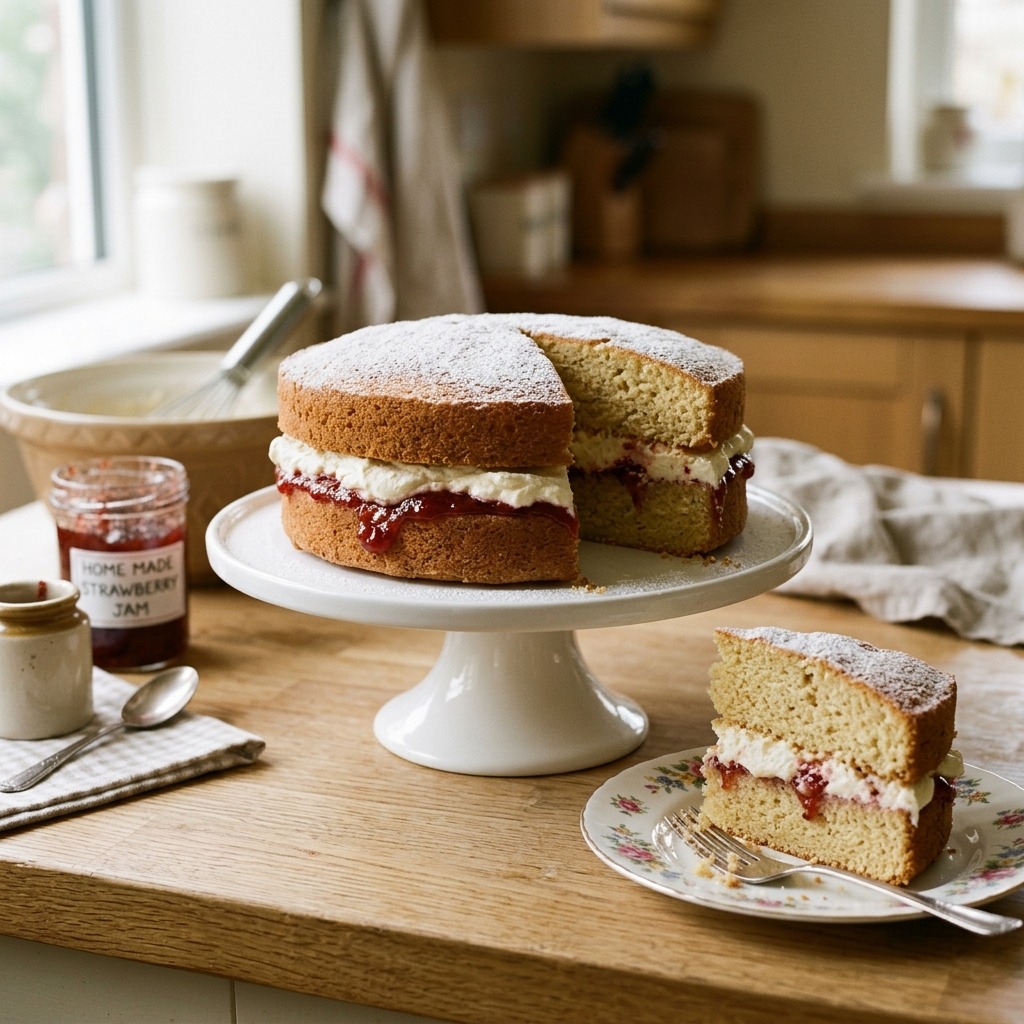
Mary Berry's Victoria sponge is a light, golden British cake made with equal weights of butter, sugar, flour, and eggs, filled with raspberry jam and whipped cream. She uses the all-in-one method, everything beaten together at once so beginners get a fluffy, even crumb with minimal fuss in under an hour.
Recipe Overview at a Glance
| Detail | Information |
|---|---|
| Prep time | 15 minutes |
| Bake time | 25 minutes |
| Cooling time | 30 minutes |
| Total time | ~70 minutes |
| Servings | 8 slices |
| Calories (per slice) | ~480 kcal |
| Difficulty | Easy (beginner-friendly) |
| Tin size | 2 x 8-inch (20cm) round tins |
How Do You Make Mary Berry's Victoria Sponge? (Quick Method)
- Preheat the oven to 180°C (160°C fan / 350°F).
- Beat all sponge ingredients together until smooth.
- Divide between two greased, lined tins.
- Bake for 25 minutes until golden and springy.
- Cool, then fill with jam and whipped cream.
- Dust with sugar and serve.
That's the shortcut. Below, you'll find the detailed version with measurements, visual cues, and expert tips.
The History and Charm of the Victoria Sponge
The cake takes its name from Queen Victoria, who enjoyed a slice with her afternoon tea. After Prince Albert's death, Victoria's lady-in-waiting Anna, the Duchess of Bedford, helped popularize afternoon tea and the sponge became a fixture.
The original recipe was filled only with jam. Cream came later, as refrigeration made fresh dairy easier to store. Today the jam-and-cream combination is the standard, though purists still debate whether cream belongs at all.
Why does it endure? It's simple, affordable, and endlessly adaptable. The Women's Institute even uses a strict version (jam only, no cream) as a benchmark for judging baking competitions across the UK.
Ingredients: Why Quality Matters
Mary Berry's recipe follows the classic equal-weight ratio. For two 8-inch sponges:
For the sponge:
- 225g (8 oz) softened unsalted butter
- 225g (8 oz) caster sugar
- 4 large eggs, at room temperature
- 225g (8 oz) self-raising flour
- 2 tsp baking powder
- 1 tsp vanilla extract (optional)
For the filling:
- 4–6 tbsp raspberry or strawberry jam
- 300ml (½ pint) double cream, whipped
- Icing or caster sugar, for dusting
What Does Each Ingredient Do?
| Ingredient | Function |
|---|---|
| Butter | Adds richness and moisture |
| Caster sugar | Sweetens and helps create a tender crumb |
| Eggs | Bind and add structure plus lift |
| Self-raising flour | Provides the rise and framework |
| Baking powder | Extra insurance for a tall, even sponge |
Why Should Ingredients Be at Room Temperature?
Cold butter won't beat smoothly, and cold eggs can curdle the batter. Room-temperature ingredients blend into a silky mixture that traps air essential for a light sponge. Take everything out of the fridge an hour before baking.
What Is the All-in-One Method (and Why Does Mary Berry Use It)?
Traditional sponges use the creaming method: beat butter and sugar first, then add eggs and flour in stages. Mary Berry favors the all-in-one method for this recipe: you simply beat every ingredient together at once.
| Method | Steps | Best for |
|---|---|---|
| Creaming | Multiple stages, longer | Bakers who want maximum air |
| All-in-one | One bowl, one beat | Beginners and speed |
The all-in-one approach works because the added baking powder guarantees the rise, so you don't rely solely on air beaten into the butter. It's faster, harder to mess up, and produces consistent results.
Step-by-Step Instructions
- Prep your tins. Grease two 8-inch round tins and line the bases with parchment.
- Combine everything. Put butter, sugar, eggs, flour, baking powder, and vanilla into a large bowl.
- Beat until smooth. Use an electric mixer for about 2 minutes, just until the batter is well blended and pale. Don't overbeat.
- Divide the batter. Spoon equally into both tins and level the tops. (A kitchen scale ensures even layers.)
- Bake. Place on the middle shelf at 180°C (160°C fan) for 25 minutes.
- Check doneness. The sponges should be golden, springy to the touch, and shrinking slightly from the tin edges. A skewer should come out clean.
- Cool. Rest in the tins for 5 minutes, then turn out onto a wire rack and peel off the parchment.
How Do You Make the Perfect Jam and Cream Filling?
Once the sponges are completely cool, it's time to assemble.
- Choose your jam. Raspberry is traditional; strawberry is a popular alternative. Use a good-quality jam with real fruit content.
- Whip the cream. Beat 300ml double cream until it holds soft peaks. Stop before it turns stiff and grainy. Add 1 tbsp sugar if you like it sweeter.
- Assemble. Spread jam on the bottom sponge, then top with whipped cream. Place the second sponge on top.
- Finish. Dust with icing or caster sugar.
Mary Berry Victoria Sponge with Buttercream
Prefer buttercream to fresh cream? Buttercream holds up longer at room temperature, making it ideal for warm days or transporting cakes.
Mary Berry's vanilla buttercream:
- 100g (3½ oz) softened butter
- 225g (8 oz) icing sugar, sifted
- 1 tsp vanilla extract
- 1–2 tbsp milk
Beat the butter until soft, gradually add the icing sugar, then mix in vanilla and enough milk to reach a spreadable consistency. Spread over the bottom sponge, add jam, and sandwich together.
Mary Berry Chocolate Buttercream
For a chocolate twist, swap 25g of the icing sugar for cocoa powder, or melt 50g dark chocolate and beat it in once cooled. This pairs beautifully with a chocolate sponge for birthday cakes.
How Do You Scale the Recipe for Larger Cakes?
The equal-weight ratio makes scaling easy. Here's a quick reference:
| Tin size | Butter / Sugar / Flour | Eggs | Bake time |
|---|---|---|---|
| 7-inch (18cm) | 175g each | 3 | 20–25 min |
| 8-inch (20cm) | 225g each | 4 | 25 min |
| 9-inch (23cm) | 280g each | 5 | 25–30 min |
| 10-inch (25cm) | 350g each | 6 | 30–35 min |
For a Mary Berry birthday cake, use the 9 or 10-inch version, fill with buttercream and jam, and decorate with sprinkles, fresh berries, or a chocolate ganache drip.
Troubleshooting: Common Victoria Sponge Problems
| Problem | Likely cause | Fix |
|---|---|---|
| Sinks in the middle | Oven opened too early; too much raising agent | Keep door shut; measure carefully |
| Dry sponge | Overbaked; too much flour | Check at 22 min; weigh flour |
| Uneven rise | Tins unevenly filled; oven hot spots | Weigh batter; rotate tins |
| Crumbly texture | Overbeaten or overbaked | Beat just until smooth |
| Dense, flat cake | Cold ingredients; expired baking powder | Use room-temp items; fresh powder |
What Are the Best Variations and Personal Touches?
- Lemon sponge: Add the zest of one lemon to the batter and use lemon curd in the filling.
- Coffee and walnut: Add 1 tbsp dissolved instant coffee and fold in chopped walnuts.
- Berry layered: Add fresh sliced strawberries alongside the jam and cream.
- Decoration: Top with fresh berries, edible flowers, or a simple dusting of icing sugar.
Dietary Adaptations
| Need | Swap |
|---|---|
| Gluten-free | Use gluten-free self-raising flour + ½ tsp xanthan gum |
| Dairy-free | Plant-based block butter + coconut cream |
| Reduced sugar | Cut sugar by 25g; flavor with extra vanilla |
How Should You Serve and Store a Victoria Sponge?
Serve at room temperature, sliced into wedges, with a cup of tea the classic British way.
Storage tips:
- Cream-filled: Refrigerate and eat within 2 days.
- Buttercream-filled: Store in an airtight container at room temperature for up to 3 days.
- Unfilled sponges: Freeze (wrapped) for up to 3 months. Thaw before filling.
Frequently Asked Questions
What's the difference between a sponge cake and a Victoria sponge?
A true sponge cake relies on whipped eggs for lift and often contains little or no fat. A Victoria sponge is a butter-based cake (a "pound cake" style) using equal weights of butter, sugar, flour, and eggs, plus a raising agent.
What is the 3-2-1 rule in baking?
The 3-2-1 rule typically refers to pastry ratios (3 parts flour, 2 parts fat, 1 part water). A Victoria sponge instead uses a 1-1-1-1 equal-weight ratio of butter, sugar, flour, and eggs.
How do I make my Victoria sponge light and fluffy?
Use room-temperature ingredients, don't overbeat the batter, include baking powder, and avoid opening the oven before 20 minutes. These four steps create the lightest crumb.
What is the secret to a good Victoria sponge?
The secret is the equal-weight ratio combined with the all-in-one mixing method, plus baking powder for guaranteed lift. Precise measuring matters more than fancy technique.
Can I make a Victoria sponge ahead of time?
Yes. Bake the sponges up to a day ahead and store them airtight, or freeze unfilled sponges for up to 3 months. Fill on the day you plan to serve for the freshest result.
Why did my Victoria sponge sink in the middle?
The most common causes are opening the oven door too early, an oven that runs too cool, or too much raising agent. Keep the door shut until at least 20 minutes have passed.
Can I use plain flour instead of self-raising?
Yes add 2 teaspoons of baking powder per 225g of plain flour to mimic self-raising flour. The recipe already includes extra baking powder, so adjust accordingly.
How long does a Victoria sponge last?
A cream-filled sponge lasts 2 days refrigerated. A buttercream version keeps 3 days at room temperature in an airtight container. Plain sponges freeze for up to 3 months.
Can I make a Victoria sponge without eggs?
You can substitute each egg with 60g of unsweetened applesauce or a commercial egg replacer, though the texture will be slightly denser and less airy than the original.
Mary Berry's Victoria Sponge
Ingredients
For the sponge
- 225g (8 oz) softened unsalted butter
- 225g (8 oz) caster sugar
- 4 large eggs, at room temperature
- 225g (8 oz) self-raising flour
- 2 tsp baking powder
- 1 tsp vanilla extract (optional)
For the filling
- 4–6 tbsp raspberry or strawberry jam
- 300ml (½ pint) double cream, whipped
- Icing or caster sugar, for dusting
Instructions
- Prep your tins: Grease two 8-inch round tins and line the bases with parchment.
- Combine everything: Put butter, sugar, eggs, flour, baking powder, and vanilla into a large bowl.
- Beat until smooth: Use an electric mixer for about 2 minutes, just until the batter is well blended and pale. Don't overbeat.
- Divide the batter: Spoon equally into both tins and level the tops. A kitchen scale ensures even layers.
- Bake: Place on the middle shelf at 180°C (160°C fan) for 25 minutes.
- Check doneness: The sponges should be golden, springy to the touch, and shrinking slightly from the tin edges. A skewer should come out clean.
- Cool: Rest in the tins for 5 minutes, then turn out onto a wire rack and peel off the parchment.
- Fill and finish: Spread jam on the bottom sponge, top with whipped cream, sandwich with the second sponge, and dust with icing or caster sugar.