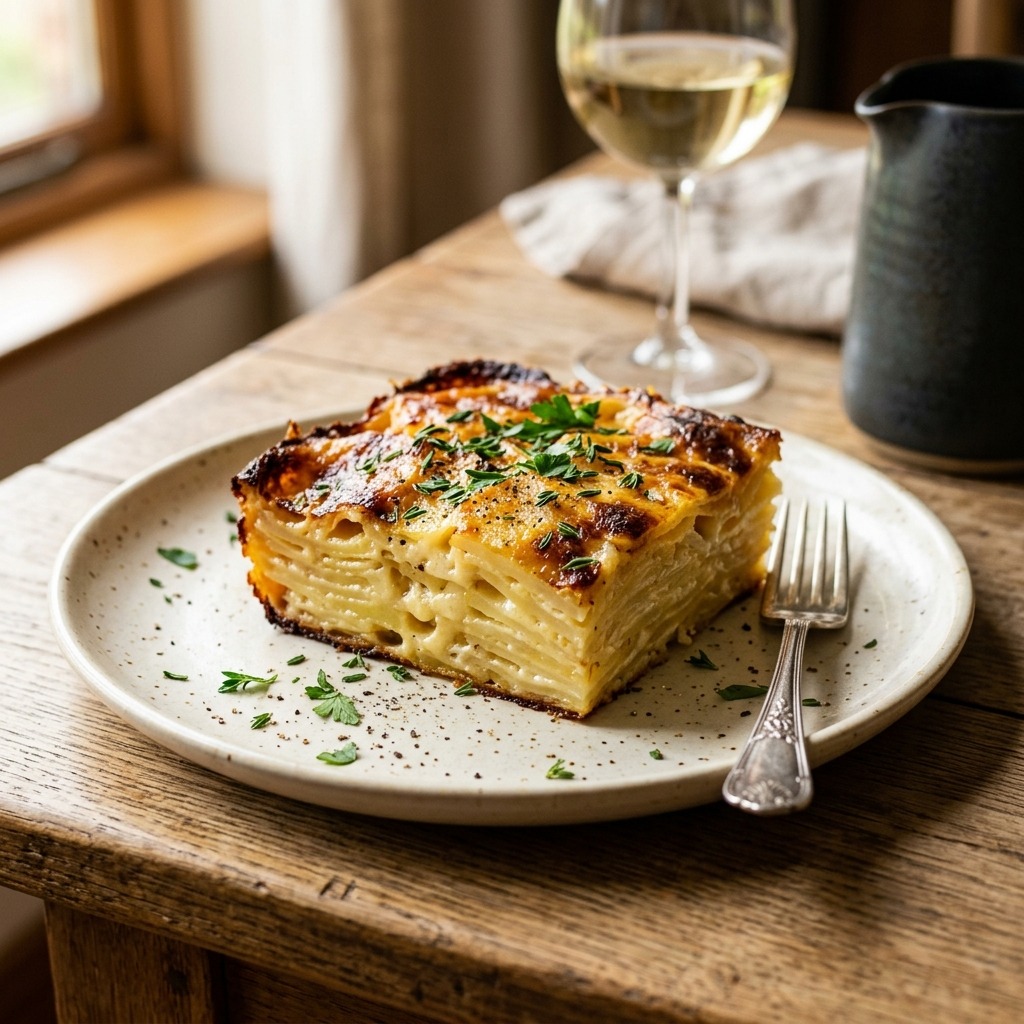
Mary Berry’s dauphinoise potatoes combine thinly sliced King Edward and sweet potatoes layered with double cream, chicken stock, and Parmesan cheese. Baked covered for 40 minutes then uncovered for 25–30 minutes, the result is a golden, creamy gratin that’s richer and more texturally complex than the traditional French version.
Few dishes signal “special occasion” quite like a bubbling tray of dauphinoise potatoes pulled from the oven. And when Mary Berry Cordon Bleu-trained culinary icon and beloved figure of British home cooking puts her stamp on a classic, home cooks pay attention.
Recipe Overview
|
Detail |
Info |
|
Prep Time |
20 minutes |
|
Cook Time |
65–70 minutes |
|
Servings |
6 |
|
Difficulty |
Easy |
|
Calories (est.) |
~380 per serving |
|
Storage |
3 days (fridge), 3 months (freezer) |
|
Best For |
Sunday lunches, dinner parties |
What Are Dauphinoise Potatoes And Where Did They Come From?
Dauphinoise potatoes, or gratin dauphinois, originate from the Dauphiné region of southeastern France a historic territory now covering the departments of Isère, Drôme, and Hautes-Alpes.
The dish was first officially documented on July 12, 1788, when the Duke of Clermont-Tonnerre served it to his officers in the town of Gap. That early version was modest: thinly sliced potatoes cooked in whole milk with garlic. No cream, no cheese.
Over the centuries, the recipe evolved. Cream replaced milk. Gruyère and Parmesan appeared in certain regional variations. By the time the dish reached British kitchens, it had become the rich, golden gratin we know today a go-to for Sunday lunches and festive menus alike.
Traditional French ingredients include:
- Floury potatoes (Charlotte or Monalisa varieties in France)
- Whole milk or a milk-cream mixture
- Garlic
- Salt and pepper
- Optional: aged cheese for a gratin effect
What Makes Mary Berry’s Dauphinoise Potatoes Different?
Mary Berry’s version, published in Mary Berry’s Family Sunday Lunches, departs from tradition in one key way: she uses both King Edward and sweet potatoes in equal quantities.
This combination achieves something the classic recipe doesn’t:
- King Edwards provide the fluffy, starchy base that absorbs the cream beautifully
- Sweet potatoes add natural sweetness, a softer texture, and warm colour
- Parmesan on top creates a golden, savory crust that contrasts with the creamy layers underneath
The result is visually striking and more complex in flavor. Gordon Ramsay uses a similar sweet potato approach in his version, suggesting this is a technique gaining credibility beyond Mary Berry’s kitchen.
Mary Berry’s Dauphinoise Potatoes: Ingredients
What You’ll Need
Produce:
- 750g (1 lb 10 oz) King Edward potatoes, peeled
- 750g (1 lb 10 oz) sweet potatoes, peeled
Dairy & Fats:
- 300ml (½ pint) double cream
- 150ml (¼ pint) chicken or vegetable stock
- Butter (for greasing the dish)
- Parmesan cheese (for topping)
Seasoning:
- Salt and black pepper to taste
Ingredient Substitutions
|
Original Ingredient |
Substitution |
Notes |
|
King Edward potatoes |
Maris Piper |
Similar floury texture |
|
Sweet potatoes |
All King Edwards |
Traditional result |
|
Double cream |
Single cream |
Less rich, thinner sauce |
|
Chicken stock |
Vegetable stock |
Makes it vegetarian |
|
Parmesan |
Gruyère or Cheddar |
Slightly different flavor |
|
Butter |
Dairy-free spread |
For dairy-free option |
Equipment Needed
- Large baking dish (approx. 30 x 20cm)
- Sharp knife, mandolin, or food processor with slicing blade
- Aluminum foil
- Measuring jug
- Cutting board
How to Make Mary Berry’s Dauphinoise Potatoes: Step-by-Step
Step 1: Preheat and Prepare
Preheat your oven to 160°C fan / 180°C / Gas Mark 4. Generously butter your baking dish.
Step 2: Slice the Potatoes
Peel both types of potatoes and slice them very finely approximately 3mm thick. A mandolin or food processor gives the most consistent results. Uniform slices ensure even cooking throughout.
Step 3: Layer the Potatoes
Alternate layers of King Edward and sweet potato slices in the buttered dish. Season each layer with salt and black pepper as you go. Don’t skip seasoning between layers this is where flavor is built.
Step 4: Add the Liquid
Mix the double cream and stock together, then pour evenly over the layered potatoes. Press down firmly on the mixture to compress the layers and ensure the liquid seeps through.
Step 5: Top with Parmesan
Cover the top generously with grated Parmesan cheese.
Step 6: Bake
- First 40 minutes: Cover tightly with aluminum foil and bake
- Final 25–30 minutes: Remove the foil and bake uncovered until the top is deep golden brown and the potatoes are tender when tested with a knife
How to Tell When It’s Done
The dish is ready when:
- The top is golden and lightly crisp
- A sharp knife slides through the layers without resistance
- The edges are bubbling gently
Mary Berry’s Top Tips for the Best Results
- Slice consistently thin. Thick slices won’t cook through evenly, leaving the centre underdone while the top browns.
- Press the layers down. Compressing the potatoes before baking gives a more structured, sliceable gratin.
- Use fresh Parmesan. Pre-grated Parmesan doesn’t melt as well and won’t give you the same golden crust.
- Don’t rush the foil stage. The first 40 minutes covered is what steams the potatoes through removing foil early leads to a dry, undercooked base.
- Rest before serving. Like most baked dishes, dauphinoise benefits from 10–15 minutes resting time, which makes it easier to portion and improves the texture.
Common Mistakes to Avoid
|
Mistake |
Why It Matters |
Fix |
|
Slicing potatoes too thick |
Uneven cooking |
Aim for 3mm slices |
|
Skipping seasoning between layers |
Bland result |
Season every layer |
|
Using low-fat cream |
Sauce won’t emulsify properly |
Stick to double cream |
|
Removing foil too early |
Dry, crusty top, raw centre |
Keep foil on for full 40 minutes |
|
Not pressing layers down |
Uneven texture, gaps |
Compress before adding liquid |
|
Using the wrong potato variety |
Waxy potatoes won’t absorb cream |
Use floury varieties only |
What Should You Serve with Dauphinoise Potatoes?
Mary Berry’s dauphinoise works beautifully alongside:
Meat mains:
- Slow-roasted leg of lamb
- Roast beef with horseradish
- Pan-seared duck breast
- Whole roast chicken
Vegetables:
- Steamed green beans or tenderstem broccoli
- Wilted spinach with garlic
- Glazed carrots
What Wine Pairs Well with Dauphinoise Potatoes?
The richness of the cream and Parmesan calls for wines with structure and depth:
- Red: Claret (Bordeaux), Côtes du Rhône (Syrah/Grenache blend), Minervois
- White: White Burgundy (Chardonnay), Viognier
Can You Make Dauphinoise Potatoes Ahead of Time?
Yes and it’s actually recommended. Making this dish a day ahead allows the flavors to deepen and makes portioning much cleaner.
Make-ahead instructions:
- Bake fully, then allow to cool completely
- Cover and refrigerate for up to 24 hours
- Reheat covered at 160°C fan for 20–25 minutes, then remove foil for a further 10 minutes
Can you freeze dauphinoise potatoes?
Yes, though the texture changes slightly. Freeze for up to 3 months in an airtight container. Thaw overnight in the fridge and reheat as above. Expect a softer texture after freezing the cream sauce can separate slightly, though stirring helps.
Dietary Variations
Dairy-Free Dauphinoise Potatoes
Replace double cream with unsweetened cashew cream or full-fat coconut cream. Use dairy-free spread to grease the dish and top with dairy-free cheese. The flavor profile changes noticeably, but the texture remains creamy.
Gluten-Free Dauphinoise Potatoes
Good news: this dish is naturally gluten-free. No modifications needed just check that your stock is certified gluten-free.
Vegan Dauphinoise Potatoes
Combine dairy-free cream, vegetable stock, and nutritional yeast for a savory, cheese-like flavor. Layer with thinly sliced potatoes and top with breadcrumbs (gluten-free if needed) for crunch.
Nutrition Information (Per Serving, Approx.)
|
Nutrient |
Amount |
|
Calories |
~380 kcal |
|
Carbohydrates |
34g |
|
Fat |
22g |
|
Protein |
8g |
|
Saturated Fat |
13g |
|
Sodium |
~450mg |
Frequently Asked Questions
What potatoes does Mary Berry use in her dauphinoise recipe?
Mary Berry uses equal quantities of King Edward and sweet potatoes 750g of each. King Edwards provide a fluffy, starchy base, while sweet potatoes add natural sweetness and color. Maris Piper is the best substitute if King Edwards are unavailable.
Why does Mary Berry add sweet potato to dauphinoise?
Sweet potatoes make the dish more visually striking and add a subtle sweetness that balances the richness of the cream and Parmesan. They also create a slightly softer texture in contrast to the fluffier King Edwards.
What temperature should dauphinoise potatoes be cooked at?
Mary Berry bakes her dauphinoise at 160°C fan / 180°C / Gas Mark 4 first covered with foil for 40 minutes, then uncovered for 25–30 minutes until golden.
Can dauphinoise potatoes be made the night before?
Yes. Bake the dish fully, cool completely, and refrigerate overnight. Reheat covered at 160°C fan for 20–25 minutes, then uncovered for 10 more minutes to refresh the crust.
How long do leftover dauphinoise potatoes last in the fridge?
Stored in an airtight container, leftovers keep for up to 3 days in the refrigerator.
Can you freeze Mary Berry’s dauphinoise potatoes?
Yes, for up to 3 months. Expect a slight change in texture after freezing the cream sauce may separate slightly. Thaw overnight in the fridge before reheating.
What is the difference between dauphinoise potatoes and scalloped potatoes?
Dauphinoise potatoes use cream and are typically topped with cheese for a gratin finish. Scalloped potatoes traditionally use a milk-based white sauce. Dauphinoise is richer and has French origins; scalloped potatoes are more common in North American cooking.
How do you stop dauphinoise potatoes from being watery?
Use floury potatoes (King Edward or Maris Piper), slice them thinly and evenly, and avoid waxy varieties like new potatoes. Pressing the layers down firmly before baking also reduces excess moisture.
What is the origin of dauphinoise potatoes?
The dish was first documented on July 12, 1788, when the Duke of Clermont-Tonnerre served it to his officers in Gap, France. It originated in the Dauphiné region of southeastern France.
Is dauphinoise potatoes the same as gratin dauphinois?
Yes. “Dauphinoise potatoes” and “gratin dauphinois” refer to the same dish. The British term is “dauphinoise potatoes”; the French call it gratin dauphinois. Both describe thinly sliced potatoes baked in cream.